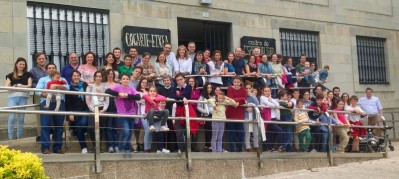
The Spiritual Exercises for Families, organized by the Loyola Spirituality Center, took place 30 April to 3 May 2015. Thirty-four adults and 32 children from Durango, Tudela, Oviedo, Gijón, Albacete, Barcelona, Madrid, and Murcia participated. Some, associated with works of the Society, some not; some experienced with the Exercises and others who did them for the first time. Young couples 30 years of age with their first children and others 50 years old with teenage children. Of the children, nine were babies and 23 were between six and 15 years old, two of them with Down syndrome.
Damián Picornell, SJ, was in charge of running the retreat, with the help of a team of nine assistants from Salamanca, San Sebastian, Albacete, Valladolid, and Barcelona: Alberto Cano, SJ, Mertxe Martín, Begoña Antolínez, MDM, Julia Blázquez, ACI, Carlota Ciudad, Beatriz Bendito, Ivana Murinova, Adelaida Andrés, CVX, and Garazi Murgialdai were involved in bringing forth the initiative from the start.
The goal was to promote the Spiritual Exercises of Ignatius focusing on the family as participants in the experience, using the image of the Way: we are companions on the way to God, we walk as a family, we walk as pilgrims in the manner of Ignatius of Loyola. The different activities of the children and points given to the parents were, in turn, linked to this idea.
Each day the larger group was divided into three: the babies that stayed in the nursery placed in the Izarraitz meeting room, the children and teenagers had their activities in the hostel, and the adults made their exercises in silence. Every afternoon there was a common experience that included everyone, with group prayer led by Maite López, the theatrical visit of Ignatius’s home led by Alberto Cano and Mertxe Martín (portraying St. Ignatius and his sister-in-law Magdalena), and the closing Eucharist with the blessing of mothers and the presentation of a sandal as a souvenir and sign to continue walking.
To focus the exercises from this point of view has meant adapting themes and practices that are normally in other more classical formats. For example, reading the Principle and Foundation in the tone of a family, including in the daily Examen, and some time for couples to dialogue and employ the third mode of praying as a resource for prayer with the children. All of this generated a process for reflection that helped evaluate the experience and facilitate dissemination in other regions of the Province.
